

- Published date:
- 02 February 2026
- 81% of commercial buildings in major English cities below EPC B
- Government inaction and lack of response following 2021 consultation on minimum energy efficiency standards continues to hold back investment and delay upgrades in building stock
- Commercial building owners making progress year-on-year but ongoing uncertainty means 190 million sq. m of commercial real estate below EPC B in major cities.
The British Property Federation’s (BPF) annual analysis of EPC ratings in major cities across England finds that 81% of commercial buildings have an EPC below B.
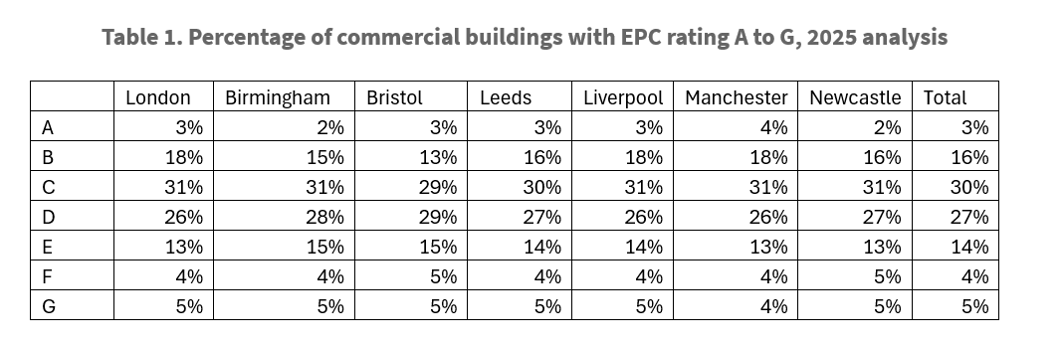
The latest research shows that progress is being made, but it is slow and being hampered by the ongoing failure of Government to respond to the 2021 consultation on future minimum energy efficiency standards. The BPF’s analysis looked at commercial buildings across all asset classes in London, Birmingham, Bristol, Leeds, Liverpool, Manchester and Newcastle and shows that 3% of commercial buildings have an EPC rating of A and a further 16% have an EPC rating of B.
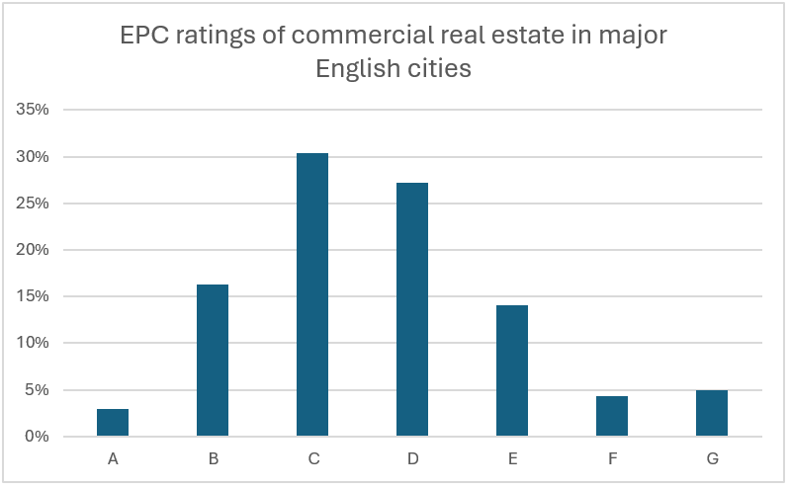
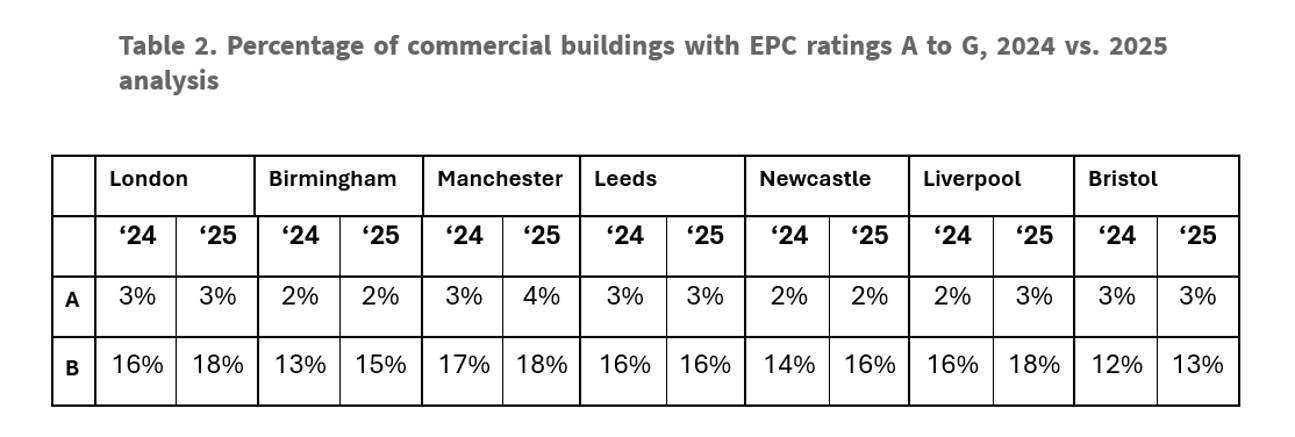
Manchester continues to lead the way with 22% of its commercial buildings securing an EPC rating of A or B, followed closely by London at 21% (see table 1). The latest analysis shows that across the seven major cities there has been a one or two percentage point increase in the number of commercial buildings securing an EPC rating of B (see table 2). This highlights that while progress is happening, the pace is very slow and millions of sq. m. of office, retail and industrial space is at risk of becoming obsolete unless Government provides urgent clarity on future regulations.
The 2021 consultation on minimum energy efficiency standards sought views on a target of EPC C by 2027 and EPC B by 2030. Industry had hoped a response to the consultation would be published as part of the recent Warm Homes Plan. However, the lack of a Government response means that the 2027 and 2030 targets are now completely unrealistic. The BPF is urging the Government to publish a response without further delay to give the real estate industry sufficient time to make investment decisions and ensure the regulations are implemented effectively.
Rob Wall, Assistant Director, British Property Federation, said, “The Warm Homes Plan has left commercial landlords in the dark and out in the cold. We have been waiting for five years for a decision on future minimum energy efficiency standards for the non-domestic private rented sector. It is beyond belief that Ministers have kicked the can down the road once again.
“Our latest research shows some improvement in the EPC ratings of commercial buildings and this reflects what we see in the market, certainly when it comes to new buildings. However, the lack of any real policy development under this Government on upgrading commercial property is leaving commercial tenants with higher energy bills and undermining efforts to decarbonise our buildings.
“Many in the industry support higher minimum standards but progress will remain slow as long as Ministers continue to duck decisions. Clarity on future standards is critical to increasing demand, attracting investment and building green skills and supply chains.”
Methodology
The analysis was carried out on the Ministry of Housing, Communities and Local Government’s Energy Performance of Buildings Data: England and Wales. The dataset is ‘The Energy Performance Certificates’ updated on 25 Dec 2025 and includes certificates issued up to and including 30 Nov 2025.

Share this article